

JANUARY 2026
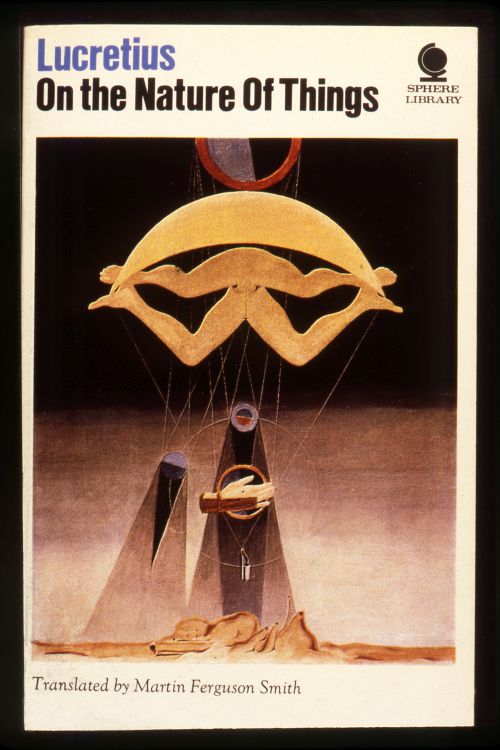
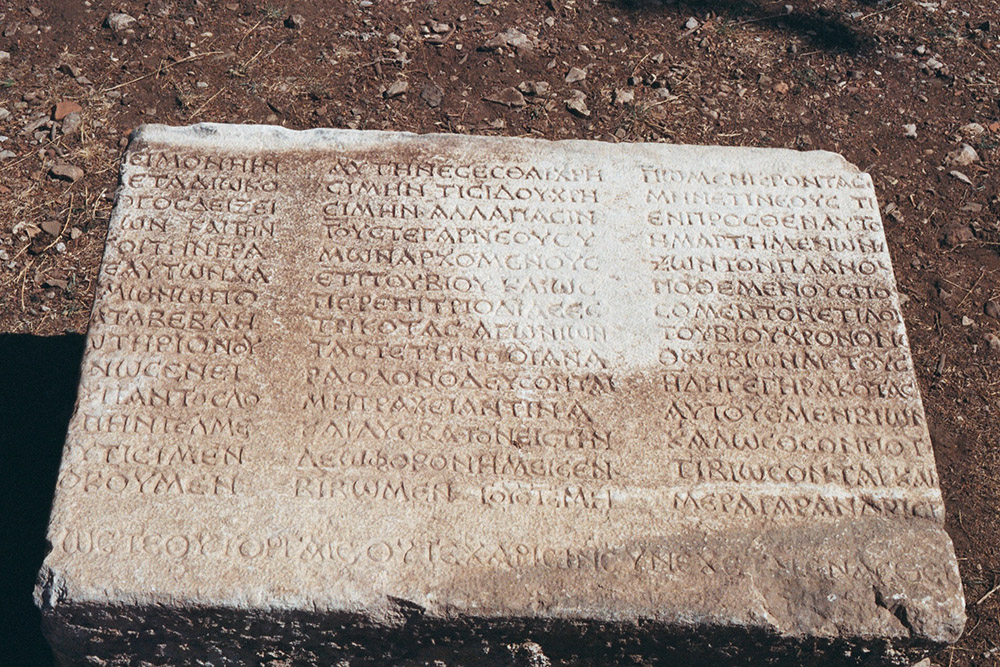
(1) Urbi et Orbi: The Epicurean Inscription and Prescription of Diogenes of Oinoanda. English translation of the Greek, with Introduction and Notes, by Martin Ferguson Smith, Doxai Series: Testi e studi di filosofia antica, Tab edizioni, Rome. Open Access and paperback. Expected early April 2026.
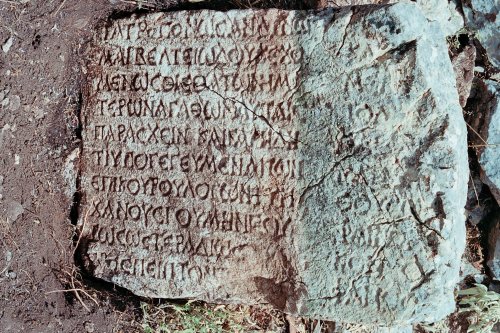
Diogenes has a message of moral healing and salvation for his fellow citizens, and also for so-called foreigners who are actually fellow citizens in a world which is a single country and home for humanity. His gigantic Greek inscription, the longest known from the ancient world, is one of the most remarkable classical finds of the last two centuries. It also has the fascination of an unfinished jigsaw puzzle.
Urbi et Orbi is essential reading for all who are interested in philosophy, and is highly relevant to the modern world.
(2) Martin the Epicurean
Autobiography of Martin Ferguson Smith. SilverWood Books. Paperback and e-book. Expected April 2026.
The book tells the story of Martin's education in England and Ireland; his career as a university teacher in Wales and England and as a distinguished researcher and writer. Highlights include: his discoveries and studies of Greek philosophical texts at Oinoanda in Turkey; his unusual experiences in communist Albania and Romania; and his thirty years of contented isolation on the remote island of Foula in Shetland during which time he has written extensively about twentieth-century writers, artists, and social reformers.
*** Further information about both new books will be provided as soon as it is available, so watch this space!
The bulky and eagerly-awaited work presenting the results of the German-led survey of Oinoanda in 2007-2015 was published in December 2025. It includes the section mentioned here:
“Die epikureische Inschrift des Diogenes von Oinoanda”, in M. Bachmann, J. Hammerstaedt, E. Laufer (eds), Oinoanda: Ergebnisse der Surveys 2007-2015: Bauforschung, Archäologie, Epigraphik, Deutsches Archäologisches Institut, Istanbuler Forschungen 57, Wiesbaden, 2025, 371-393. With Jürgen Hammerstaedt. In German.
Many other sections of the work contain numerous mentions of Diogenes.APRIL 2025
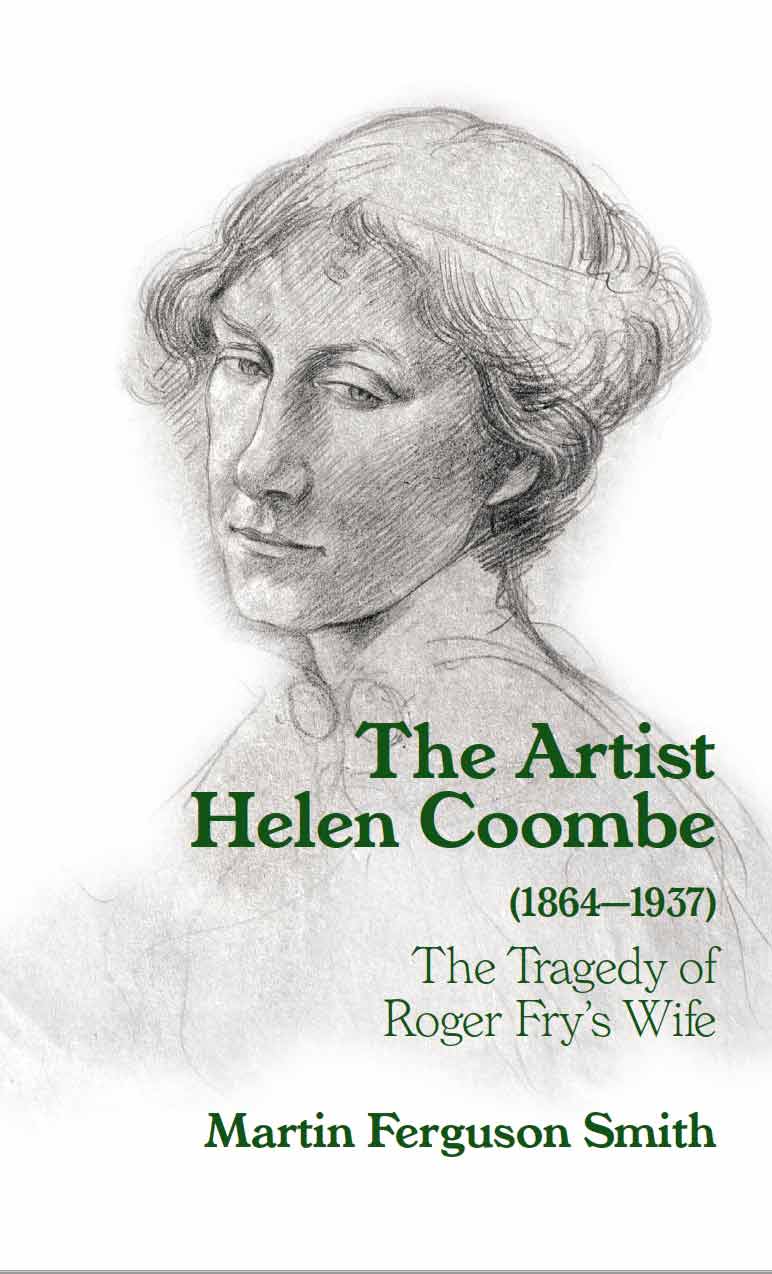
The Artist Helen Coombe (1864-1937): The Tragedy of Roger Fry’s Wife.
London: Paul Holberton Publishing for Hogarth Arts. Hardback, published 1 October 2023.
72 illustrations. ISBN 978-1-913645-53-3, RRP £45 (€50, $55).
The book continues to receive high praise, and not only from art historians.
“The deeply moving chronicle of an artist whose promising career was
cut short by severe mental illness. … Smith’s fine book poignantly
evokes Helen Coombe’s tragic life while also richly celebrating her creative talent.”
The British Art Journal (Peter Cormack)
"The tragedy of Helen's illness is deepened and darkened by her brilliance as an artist. ...
Brilliantly illuminating and deeply moving, The Artist Helen Coombe is a biographical treasure."
English Studies (Linda Elisabeth LaPinta)
“Meticulous biography …Little of [Coombe’s] work survives, but
illustrations here give flashes of her genius.”
RA [Royal Academy] Magazine (Ed Bankes)
""Coombe ... was not some generic madwoman in the attic, but a painter and designer of note,
a far better one than Fry had ever been. ... Smith aims to give Coombe back her identity,
not only as an artist of considerable achievement, but also as a woman with a distinct emotional
and social trajectory. ... The correspondence [between the couple], especially on Coombe's side,
flashes with wit, intelligence and despair".
The Times Literary Supplement, "His better half: A painter and designer who outshone her famous husband" (Kathryn Hughes)
“A compelling and meticulously researched biography.”
Virginia Woolf Bulletin (Wendy Jones Nakanishi)
“Highly original and an absolutely key contribution to the convoluted and
often muddled history of the Bloomsbury Group - in its widest sense.”
Robin Simon, Editor of The British Art Journal
"A magisterial achievement".
Marianne Thormählen, Professor emerita, Lund University
"... a significant contribution to the history of art. ... An important story of a woman
whose struggles with her mental health robbed her of so much. ... the barriers she
faced were greater than those presented by illness alone. As a wife and mother, she
had less freedom to work than her husband, ... It is perhaps no surprise to learn that
[she] ... had no studio of her own in the marital home. I wonder what Fry's close
friend Virginia Woolf might have said about that!"
Cathy Hunt, Independent researcher
"Moved to tears."
Gela Dechert, Artist and social educator (Fränkische Schweiz, Germany)
“Meticulously researched”
Woolf Studies Annual (Elizabeth Berkowitz)
Helen Coombe was the wife of the artist and art critic Roger Fry, who was to join Virginia Woolf and a dozen or so others in the Bloomsbury Group. Although this highly original book contributes much to knowledge of Roger Fry, it focuses throughout on Helen Coombe’s life and work. It reveals a strong-minded individual, who, with little financial support from her family, trained and became established as an artist whose genius won the admiration of her contemporaries. It presents examples of her fine work, including pictures, stained glass, and decorations of musical instruments. The serious mental illness, which erupted soon after her marriage and was identified long after her death as schizophrenia, was a tragedy for her, for her husband and family, and for British art: in the last 27 years of her life, she never lived at home, never saw her children, and never fulfilled any commissions. There are strong indications that her illness’s root cause was genetic, but that it was aggravated by Roger Fry’s behaviour. He wanted a wife who would take second place to his artistic career and ambitions. This did not suit her, and in every episode of her illness she turned against him. Two of his later lovers, Vanessa Bell and Josette Coatmellec, also found him “impossible”, and, when the latter committed suicide, Virginia Woolf wondered “how long can Roger love a woman without driving her mad”.
The book is a “must” for all interested in the Bloomsbury Group, the Arts and Crafts movement, and the handling of mental illness at a time before efficacious antipsychotic drugs were available.
Helen Coombe at the Royal Academy of ArtsHelen Coombe entered the RA (Royal Academy) Schools in 1882, aged eighteen, won a prestigious prize in 1885, and probably stayed until 1888.
She was one of the students who in 1883 successfully petitioned for women to be allowed to study and draw the partially-draped figure – a
small first step towards female students achieving equality with male students. This being so, it is fitting that Martin’s new biography of her is in the RA Library, is on sale in the RA Shop, and is reviewed in the RA Magazine just in time for International Women’s Day (9 March 2024) and the artist’s 160th birthday (23 March).
For the link to Martin’s article “The Royal Academy of Arts Students’ Clubs, 1883-1902”, see below, under AUGUST 2021.
DECEMBER 2024
Artwork by Helen Coombe in Australia
The Art Gallery of South Australia (AGSA), Adelaide, has a laudable
programme of making many of the items in its collection available online.
Among them is the Trevelyan cabinet (accession number 8711F9),
designed by Roger Fry and decorated by Helen Coombe, probably
created by the artists as a wedding present for their close friend Robert ("Bob")
Calverley Trevelyan and his Dutch wife, Elizabeth ("Bessie") des
Amorie Trevelyan in 1900. Unknown to Martin when he was writing his
book about Helen Coombe, it is a welcome addition to the corpus of her
artworks.
MARCH 2024
Article on Virginia Woolf, Rose Macaulay, and the families to which they belonged
“The Stephen and Macaulay Families: Two New Letters”, Virginia Woolf Bulletin No. 75, January 2024, 28-39.
Martin presents and discusses two previously unpublished letters, written just after the death of Reginald Heber Macaulay in December 1937 and illustrative of the links between the Stephen and Macaulay families. The commentary leads on to consideration of the contacts and relations between Virginia Woolf, née Stephen, and Rose Macaulay. The article was written at the kind invitation of Sarah M. Hall, the owner of one of the letters.
Diogenes of Oinoanda meeting in Türkiye / Turkey
On 21 December 2023 a meeting devoted to the Epicurean philosopher Diogenes of Oinoanda was held in Muğla, Türkiye. The first of the four lectures, by Alp Ejder Kantoğlu, was entitled “Martin Ferguson Smith ve Oinoanda’ya Adanan Bir Ömür” (“Martin Ferguson Smith and a Life Devoted to Oinoanda”).
SEPTEMBER 2023
In and out of Bloomsbury: Biographical Essays on Twentieth-Century Writers and Artists. Manchester: Manchester University Press, first published in hardback in July 2021, re-issued in paperback, 27 June 2023. 46 illustrations. ISBN 978-1-5261-7193-1, £20.00 ($29.95).
Included in 2025 in Manchester University Press's Literature and Theatre Collection, a newly-expanded digital resource.
“Delightfully written essays packed with revelations”
Robin Simon, editor of The British Art Journal
“A wealth of colourful new material”
Odin Dekkers, former editor of English Studies
“Fascinating essays”
Mark Hussey, distinguished Bloomsbury scholar
“Masterful”
The Times Literary Supplement (Vanessa Curtis)
“A delight from beginning to end”
English Studies (Marianne Thormählen)
“Both instructs and inspires”
Literature Cambridge (Mitchell Alcrim)
“…will have broad appeal. … achieves what few academic works can boast”
VII: Journal of the Marion E. Wade Center (Luci Frerichs Parrish)
“A masterclass in pursuing and documenting research”
Woolf Studies Annual (Elizabeth Berkowitz)
*Longlisted for the William M.B. Berger Prize for British Art History 2022
Martin was invited to be an honorary guest at the Mavi Anadolu Felsefe Sempozyumu (Blue Anatolia Philosophy Symposium), held in Bodrum (ancient Halikarnassos), Turkey, on 24-25-26 April 2023. The theme of the symposium was: “Yaşam için Felsefe” : Muğlalı/Oinoandalı Diogenes’ten P. Hadot’ya [“Philosophy for Life” : From Diogenes of Muğla/Oinoanda to P. Hadot]. Martin’s paper, entitled “Diogenes of Oinoanda away from Oinoanda” and read in Turkish in his absence, mentioned Diogenes’ inclusion of material derived directly or indirectly from the historian Herodotus, Halikarnassos’s most famous cultural figure. But it focused most attention on Diogenes’ links to the island of Rhodes and Epicurean communities in mainland Greece, before concluding with mention of the philosopher’s philanthropic and cosmopolitan attitudes and their value to the modern world.
Diogenes of Oinoanda, new
“Oinoandalı Diogenes Önemi” (çev. Serena Nur Erkızan), Arkhe-logos, Cilt 8, Sayı 15 (ağustos 2023). In Turkish.
The text of a paper contributed to a colloquium in Muğla, Türkiye, in June 2022. See below, under JULY 2022.
JULY 2022
Article relevant to the Covid-19 pandemic
“Pandemics, Plagues, and Philosophy: Moral Lessons from Antiquity for the Modern World”, Antigone [online classical journal]. January 2022. Illustrated.
Epicurean and Stoic philosophers could not offer vaccines or effective medicines to combat plagues and pestilences, but they did offer moral advice to
those caught up in such events, and they were concerned to combat the plagues of false opinions that blight the lives and happiness of so many.
Their advice is as relevant today as it was in antiquity.
READ HERE: https://antigonejournal.com/2022/01/pandemic-philosophy/
New article on Diogenes of Oinoanda
“Diogenes of Oinoanda: News and Notes XIV (2019-2021)”, Cronache Ercolanesi 52 (2022) 383-399. One illustration. A survey of recent work, including details of activities and a
critical review of over fifty relevant publications. There is also a tribute to the late Jim Coulton.
READ HERE: http://www.martinfergusonsmith.com/pdf/CRONACHE.pdf
(The article is made available here by kind permission of the editors of Cronache Ercolanesi,)
Colloquium on Diogenes of Oinoanda in Muğla
On 10-11 June 2022 a colloquium on Diogenes of Oinoanda, organised by Prof. Dr. H. Nur Beyaz Erkızan, was held at Muğla Sıtkı Köçman Üniversitesi. Muğla is the capital of the Turkish province in which Oinoanda is located. The papers were given by Turkish scholars in Turkish. The colloquium was dedicated to Martin, and a translation of his opening address, on “The Importance of Diogenes of Oinoanda”, was read in his absence.
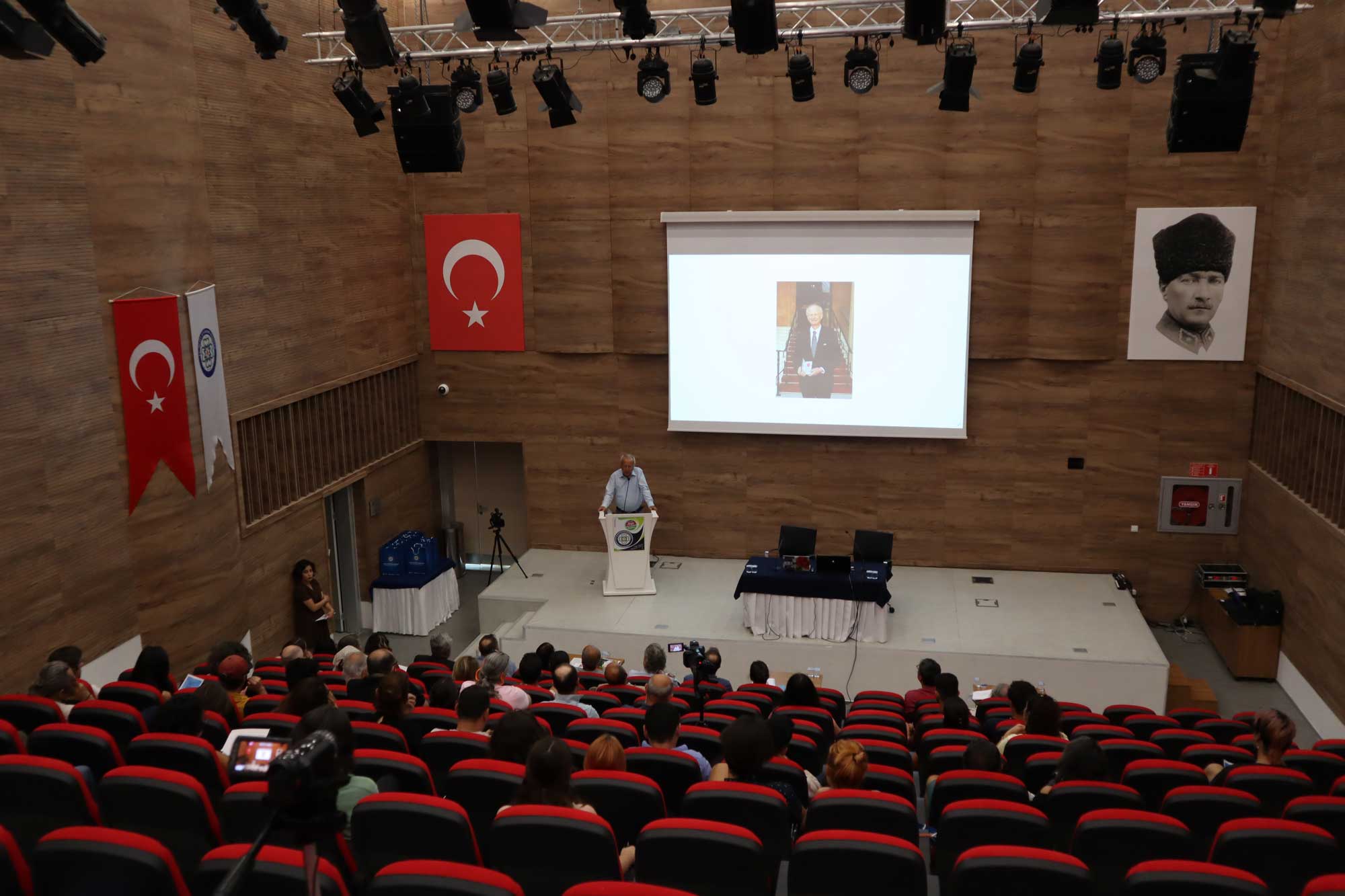
DIOGENES OF OINOANDA COLLOQUIUM, MUĞLA, JUNE 2022
AUDITORIUM DURING MARTIN’S ADDRESS
Photo: ©Levent Erkızan
The holding of the colloquium is testimony to a very welcome growing interest in Diogenes of Oinoanda among Turkish scholars. It is planned to publish the papers with summaries in English.
August 2021
“The Royal Academy of Arts Students’ Clubs, 1883-1902,” The British Art Journal 22, No. 1 (Spring 2021) 78-88. 14 illustrations.
READ HERE: www.martinfergusonsmith.com/pdf/RA 20Clubs 20BAJ 20XXII.pdf
This link is provided by kind permission of the editor of The British Art Journal
This tale of two clubs is one that has never been told before. Each club had premises close to Piccadilly Circus. The earlier one, established in 1883,
was very short lived, but hosted important and influential lectures on art by Oscar Wilde and James McNeill Whistler. The later one, opened in 1889,
held regular meetings, especially smoking concerts – a sure sign that only men were eligible for membership! The exclusion of women is considered alongside
discussion of their status and discriminatory treatment in the Royal Academy Schools in the nineteenth century. Most of the illustrations are of the posters
and invitations designed by the students.
NOVEMBER 2020
“Fifty Years of New Epicurean Discoveries at Oinoanda”, Cronache Ercolanesi 50 (2020) 241-258.
The article chronicles the remarkable story of the Greek inscription set up by the Epicurean philosopher Diogenes of Oinoanda (the longest inscription known from the ancient world) from antiquity to the present, with particular focus on the discoveries and rediscoveries made at Oinoanda in the fifty years 1968-2017. Since 1968, when Martin inaugurated new investigations, huge progress has been made. As he points out:
“The number of fragments [of the inscription] has much more than tripled, from 88 to 305, and the quantity of text has more than doubled, from about 3,550 words to about 8,000. The length of the known parts of Diogenes’ inscription is now only slightly less than the combined length of Epicurus’ Letter to Herodotus, Letter to Menoeceus, and Principal Doctrines (Kyriai Doxai).”
He concludes:“Diogenes’ inscription … deserves a special place in the history of classical studies as one of the most remarkable documents to have come down to us from antiquity.”
In a similar vein, Professor Alexander Verlinsky of Saint Petersburg wrote to Martin:“I firmly believe that your Diogenes is one of the most outstanding discoveries in classics of the last two centuries.” (E-mail, 12 November 2017, quoted here with the writer’s kind permission)
READ HERE: https://www.martinfergusonsmith.com/pdf/CRONACHEERCOLANES.pdf